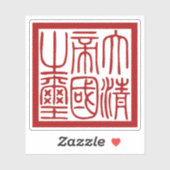

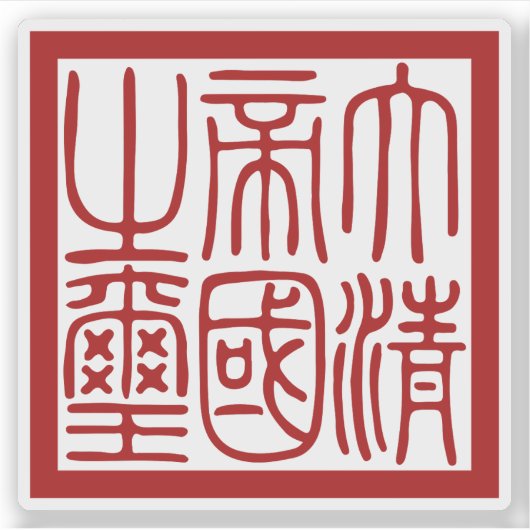
Seal of the Great Qing Empire Aufkleber (Blatt)Seal of the Great Qing Empire Aufkleber (iPad Hülle)Seal of the Great Qing Empire Aufkleber (Laptop mit iPhone)
Seal of the Great Qing Empire Aufkleber (Vorderseite)
4,10 €
pro Sticker
 

Seal of the Great Qing Empire Aufkleber

4.3 von 5 Sternen Bewertung
9 Bewertungen insgesamt
| von FlagsForAll
Produkt-Details anzeigen

Andere Designs in dieser Kategorie

Über Individuell-geschnittener Vinylaufkleber

Verkauft von

Stickerbogen-Größen: Extra-Klein 7,6 cm x 7,6 cm

Kontur-Kiss-Cut-Vinylaufkleber waren noch nie so individuell! Jetzt kannst du deine eigenen personalisierten Aufkleber entwerfen, und wir verwenden unsere patentierte Laser-Kiss-Cut-Technologie, um sie perfekt im Die-Cut-Stil auszuschneiden! Du kannst ein einzelnes Design hinzufügen, um einen perfekten Aufkleber zu erstellen, oder mehrere verschiedene Designs auf ein Blatt setzen und ein Aufkleberblatt gestalten – jedes wunderschön gedruckt und einzeln kiss-cut. Mit den individuellen Kiss-Cut-Aufklebern von Zazzle kannst du deinen einzigartigen Stil wirklich zur Geltung bringen!

  • Blattgröße: 7,6 cm (L) x 8,9 cm (H)
  • Designbereich: 7,6 cm (L) x 7,6 cm (H)
  • Die Aufkleber werden exakt in die Form deines Motivs auf einem Vinylblatt geschnitten
  • Abnehmbarer, schwach haftender Kleber hinterlässt keine klebrigen Rückstände
  • Wähle zwischen mattweißem, glänzend weißem oder glänzend transparentem Vinyl
  • Gedruckt mit lösungsmittelhaltigen Tinten, die lichtbeständig, wasserfest und kratzfest sind
  • Erhältlich in 6 Größen
  • Ein 0,32 cm breiter Rand wird um jeden Aufkleber hinzugefügt, um dein Design zu schützen und es von jedem Hintergrund abzuheben
⚠️ WARNUNG! Erstickungsgefahr — Kleine Teile; Nicht geeignet für Kinder unter 3 Jahren.

Über dieses Design

Seal of the Great Qing Empire Aufkleber

Seal of the Great Qing Empire Aufkleber

The Qing dynasty (/tʃɪŋ/ CHING), officially the Great Qing, was a Manchu-led imperial dynasty of China and an early modern empire in East Asia. Being the last imperial dynasty in Chinese history, the Qing dynasty was preceded by the Ming dynasty and succeeded by the Republic of China. At its height of power, the empire stretched from the Sea of Japan in the east to the Pamir Mountains in the west, and from the Mongolian Plateau in the north to the South China Sea in the south. Originally emerging from the Later Jin dynasty founded in 1616 and proclaimed in Shenyang in 1636, the dynasty seized control of the Ming capital Beijing and North China in 1644, traditionally considered the start of the dynasty's rule. The dynasty lasted until the Xinhai Revolution of October 1911 led to the abdication of the last emperor in February 1912. The multi-ethnic Qing dynasty assembled the territorial base for modern China. The Qing controlled the most territory of any dynasty in Chinese history, and in 1790 represented the fourth-largest empire in world history to that point. With over 426 million citizens in 1907, it was the most populous country in the world at the time. Nurhaci, leader of the Jianzhou Jurchens and House of Aisin-Gioro who was also a vassal of the Ming dynasty, unified Jurchen clans (known later as Manchus) and founded the Later Jin dynasty in 1616, renouncing the Ming overlordship. As the founding Khan of the Manchu state he established the Eight Banners military system, and his son Hong Taiji was declared Emperor of the Great Qing in 1636. As Ming control disintegrated, peasant rebels captured Beijing as the short-lived Shun dynasty, but the Ming general Wu Sangui opened the Shanhai Pass to the Qing army, which defeated the rebels, seized the capital, and took over the government in 1644 under the Shunzhi Emperor and his prince regent. While the Qing became a Chinese empire, resistance from Ming rump regimes and the Revolt of the Three Feudatories delayed the complete conquest until 1683, which marked the beginning of the High Qing era. As an emperor of Manchu ethnic origin, the Kangxi Emperor (1661–1722) consolidated control, relished the role of a Confucian ruler, patronised Buddhism (including Tibetan Buddhism), encouraged scholarship, population and economic growth. Han officials worked under or in parallel with Manchu officials. To maintain prominence over its neighbors, the Qing leveraged and adapted the traditional tributary system employed by previous dynasties, enabling their continued predominance in affairs with countries on its periphery like Joseon Korea and the Lê dynasty in Vietnam, while extending its control over Inner Asia including Tibet, Mongolia, and Xinjiang. The Qing dynasty reached its apex during the reign of the Qianlong Emperor (1735–1796), who led the Ten Great Campaigns of conquest, and personally supervised Confucian cultural projects. After his death, the dynasty faced internal revolts, economic disruption, official corruption, foreign intrusion, and the reluctance of Confucian elites to change their mindset. With peace and prosperity, the population rose to 400 million, but taxes and government revenues were fixed at a low rate, soon leading to a fiscal crisis. Following China's defeat in the Opium Wars, Western colonial powers forced the Qing government to sign unequal treaties, granting them trading privileges, extraterritoriality and treaty ports under their control. The Taiping Rebellion (1850–1864) and the Dungan Revolt (1862–1877) in western China led to the deaths of over 20 million people, from famine, disease, and war. The Tongzhi Restoration in the 1860s brought vigorous reforms and the introduction of foreign military technology in the Self-Strengthening Movement. Defeat in the First Sino-Japanese War (1894–1895) led to loss of suzerainty over Korea and cession of Taiwan to the Empire of Japan. The ambitious Hundred Days' Reform in 1898 proposed fundamental change, but was poorly executed and terminated by the Empress Dowager Cixi (1835–1908) in the Wuxu Coup. In 1900, anti-foreign Boxers killed many Chinese Christians and foreign missionaries; in retaliation, the Eight-Nation Alliance invaded China and imposed a punitive indemnity. In response, the government initiated unprecedented fiscal and administrative reforms, including elections, a new legal code, and the abolition of the imperial examination system. Sun Yat-sen and revolutionaries debated reform officials and constitutional monarchists such as Kang Youwei and Liang Qichao over how to transform the Manchu-ruled empire into a modernised Han state. After the deaths of the Guangxu Emperor and Cixi in 1908, Manchu conservatives at court blocked reforms and alienated reformers and local elites alike. The Wuchang Uprising on 10 October 1911 led to the Xinhai Revolution. The abdication of the Xuantong Emperor on 12 February 1912 brought the dynasty to an end.

Kundenrezensionen

4.3 von 5 Sternen Bewertung9 Bewertungen insgesamt
6 Gesamtbewertungen mit 5 Sternen1 Gesamtbewertungen mit 4 Sternen1 Gesamtbewertungen mit 3 Sternen1 Gesamtbewertungen mit 2 Sternen0 Gesamtbewertungen mit 1 Sternen
9 Bewertungen
Bewertungen für ähnliche Produkte
5 von 5 Sternen Bewertung
Von Viola J.12. Juli 2025Geprüfter Kauf
Groß 20,3 cm x 20,3 cm Individuell geschnittene Vinylaufkleber, Mattes Weiß
Habe die Aufkleber selber mal getestet, sie halten gut auf glatten, fettfreien und sauberen Untergründen. Der Sticker auf der Brotdose hat sogar schon ein paar Runden Spülmaschine überlebt. Länger hält es aber warscheinlich per Handwäsche. Natürlich auch perfekt für Schulbücher, Hefte etc. mit glatten Umschlägen. Ich finde super, das man die Aufkleber selber individuell personalisieren kann. Die Lieferung hat auch gut geklappt. Ich habe einmal den normalen Versand mit Sendungsverfolgung und einmal den langsamen Versand ohne Sendungsverfolgung getestet. Kam alles innerhalb der angegebenen Zeit bei mir an. Also ich kann diese Aufkleber guten Gewissens weiterempfehlen. .
5 von 5 Sternen Bewertung
Von B.14. August 2024Geprüfter Kauf
Groß 20,3 cm x 20,3 cm Individuell geschnittene Vinylaufkleber, Glänzendes Transparent
Ich kann den Artikel leider nicht verstehen :D Man muss dafür eine Lupe nutzen :D Im Großen und Ganzen meine ich, Zazzle mag Dinge recht klein drucken? Schade. Ich gebe trotzdem eine Insgesamt-Wertung von 5 Punkten, das ist ja immer subjektiv. Mini-Format, Miniatur, unleserlich, man braucht eine Lupe, wow :D
5 von 5 Sternen Bewertung
Von Tina E.9. Oktober 2023Geprüfter Kauf
Klein, 10,1 cm x 10,1 cm Individuell geschnittene Vinylaufkleber, Mattes Weiß
Bewertungsprogramm bei Zazzle
Qualität gefällt mir, Farben sind gut und kräftig und entsprechen der Abbildung. Die Verpackung war so, dass die Ware in einwandfreiem Zustand ankam. Druck wurde umgesetzt wie online abgebildet. Farben sind schön kräftig. Qualität des Aufklebers gut.

Tags

Individuell-geschnittener Vinylaufkleber
prcchinapeoples republic of china chineseimperialempireemperorflagemblemseal
Alle Produkte
prcchinapeoples republic of china chineseimperialempireemperorflagemblemseal

Andere Informationen

Produkt ID: 256981426436505911
Gemacht am: 17.7.2025, 4:17
Bewertung: G