
8,85 €
pro Schlüsselanhänger
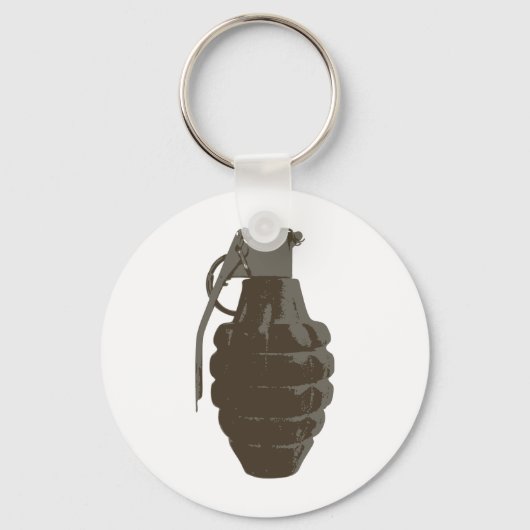
Hand Grenade War Military Bomb Army Marines Schlüsselanhänger
Produkt-Details anzeigenÜber Schlüsselanhänger
Verkauft von
Über dieses Design
Hand Grenade War Military Bomb Army Marines Schlüsselanhänger
The French military term grenade probably comes from the shape of the pomegranate fruit, which is also called grenade in French. Grenadiers were originally soldiers who specialized in throwing grenades. Today, some grenades are fired from rifles or from purpose-designed grenade launchers. Most grenades explode, projecting shrapnel, i.e., pieces of the casing, serrated wire, or an incendiary material. Some, such as smoke grenades, merely burn, releasing smoke for masking, marking, or signaling. Grenades are filled with explosive or chemical filler and have a hole into which a fuse is inserted. In modern hand grenades, the fuse is lit by an internal device rather than an external flame. The first grenades appeared in the Byzantine Empire, not long after the reign of Leo III (717-741).[2] Byzantine soldiers learned that Greek fire, a Byzantine invention of the previous century, could not only be thrown by flamethrowers at the enemy, but also in stone and ceramic jars.[2] Later, glass containers were employed. Byzantine hand grenades with Greek fire in the 10th to 12th centuries are on display in the National Museum at Athens. The use of Greek fire, or rather variants thereof, spread to Muslim armies in the Near East, from where it reached China by the 10th century.[2] Some medieval petards were small enough to be employed against enemy troops and be considered as primitive hand grenades. In China during the Song Dynasty (960–1279AD), weapons known as Zhen Tian Lei were created when Chinese soldiers packed gunpowder into ceramic or metal containers. In 1044, a military book Wujing Zongyao ("Compilation of Military Classics") described various gunpowder recipes in which one can find, according to Joseph Needham, the prototype of the modern hand grenade.[3] The first cast iron bombshells and grenades in China did not appear in Europe until 1467.[4] Within a couple centuries of this, the Chinese had discovered the explosive potential of packing hollowed cannonball shells with gunpowder. Written later by Jiao Yu in the mid 14th century book of the Huolongjing ("Fire Drake Manual"), this manuscript recorded an earlier Song-era cast iron cannon known as the "flying-cloud thunderclap eruptor" (fei yun pi-li pao). The manuscript stated that (Needham's modified Wade-Giles spelling): The shells (phao) are made of cast iron, as large as a bowl and shaped like a ball. Inside they contain half a pound of 'magic' gunpowder (shen huo). They are sent flying towards the enemy camp from an eruptor (mu phao); and when they get there a sound like a thunder-clap is heard, and flashes of light appear. If ten of these shells are fired successfully into the enemy camp, the whole place will be set ablaze...[5] This text of the Huolongjing was also important for the understanding of the Chinese hand grenade in the 14th century, as it provided much more detailed descriptions and even printed illustrations of the grenade bombs used.[6] In 1643, it is possible that "Grenados" were thrown amongst the Welsh at Holt Bridge during the English Civil War. The word "grenade" originated in the Glorious Revolution (1688), where cricket ball-sized iron spheres packed with gunpowder and fitted with slow-burning wicks were first used against the Jacobites in the battles of Killiecrankie and Glen Shiel.[7] These grenades were not very effective (probably because a direct hit would be necessary for the grenade to have effect) and, as a result, saw little use. "Cooking off" is a term referring to intentionally holding onto an armed grenade after the pin has been pulled and the handle released; allowing the fuse to burn partially to decrease the time to detonation after throwing. This technique is used to reduce the ability of the enemy to take cover or throw the grenade back. It is also used to allow the grenade to burst in the air over defensive positions.[14] This technique is inherently dangerous, since fuses may vary from grenade to grenade. Because of this the U.S. Marines (MCWP 3-35) describe cooking-off as the "least preferred technique", recommending a "hard throw, skip/bounce technique" to prevent an enemy returning a grenade. A call is usually given upon deploying a grenade, to warn friendly forces. Some yells, such as "grenade" or "fire in the hole" are used when a grenade has been thrown in by an enemy; in any instance the purpose is to warn fellow soldiers to take cover. In the U.S. Military, when a grenade is dropped into an enclosed space like a tunnel, room, or trench, the person dropping the grenade should yell "fire in the hole" to warn that an explosion is about to occur. Other U.S. military procedures include calling "frag out" to indicate that a fragmentation grenade has been deployed.

Kundenrezensionen
4.6 von 5 Sternen Bewertung79 Bewertungen insgesamt
79 Bewertungen
Bewertungen für ähnliche Produkte
4 von 5 Sternen Bewertung
Von P.12. Januar 2023 • Geprüfter Kauf
Kreisförmiger Schlüsselanhänger aus Metall, 5,08cm
Bewertungsprogramm bei Zazzle
Der Schlüsselanhänger ist echt niedlich. Der Druck ist sehr schön und kräftig, genau wie abgebildet.
Was ich nicht gut fand dass das Loch genau in das Wort Love gestanzt wurde, denn dadurch ist icht mehr alles lesbar, daher einen Punkt Abzug
5 von 5 Sternen Bewertung
Von Dragana K.6. September 2022 • Geprüfter Kauf
Kreisförmiger Schlüsselanhänger aus Metall, 5,08cm
Bewertungsprogramm bei Zazzle
Schöne Schlüsselanhänger, die Kindern waren so Glücklich... Wenn der ist angekommen :-)
Gute Qualität :-). Druck war schön und Qualität ist super.
5 von 5 Sternen Bewertung
Von Galina W.11. Mai 2016 • Geprüfter Kauf
Kreisförmiger Schlüsselanhänger aus Metall, 5,08cm
Bewertungsprogramm bei Zazzle
Ich bin sehr zufrieden mit dem Produkt: für ein Suvenir zur Jübiäums-Vorstellung geiegnet. und hoffe kommt gut an! Alles super!!!! Nur zur empfehlen!
Tags
Andere Informationen
Produkt ID: 146403673292895823
Gemacht am: 28.8.2009, 4:45
Bewertung: G
Zuletzt angesehene Produkte