


Über Tassen
Verkauft von
Über dieses Design
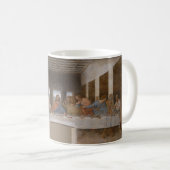
The Last Supper 1495 1498 by Leonardo da Vinci Kaffeetasse
Leonardo di ser Piero da Vinci[b] (15 April 1452 - 2 May 1519) was an Italian polymath of the High Renaissance who is active as painter, draughtsman, engineer, scientist, theorist, bildnerisch, and architect.[3] While his fame initially rested on his achievements as a INTER, HE BENOCKENKNOWN FOR HIS NOTEBOOKS, IN WHICH MADE DRAWINGS AND NOTES ON VARIETY OF SUBJEKTS, INCLUDING ANATOMY, ASTRONOMY, BOTANY, CARTOGRAPHY, PAINTING, AND PALEONTOLOGY Leonardo is widely regard ded to have been a genius epitomized the Renaissance humanist ideal,[4] and his collective works, inbegriffen: a beitrag to later generations of artists matched only by that of his younger contemporary, Michelangelo.[3][4] Born out of wedlock to a ful notary and a lower-class woman in or near, vinci, he was educated in Florence by the Italian painter and sculptor Andrea del Verrocchio. He began his career in the city, but then spent much time in the service of Ludovico Sforza in Mailand. Later, he worked in Florence and Milan again, as well briefly in Rom, all while attracting a large following of imitators and students. Upon the einladung of Francis I, he spent his last three years in Frankreich, where he died in 1519. Since his death, there has not been a time where his achievements, diverse Interests, personal life and empirical thinking have failed to incite interest and bemiration,[3][4] making him a fretent namesake and subjeject in culture. Leonardo is as one of the greatest painters in the history of art and is identifidited as the founder of the High Renaissance.[3] Despite having many lost works and less than 25 attributed major works—including unfinished works—he created some of the einflussreichen paintings Tern Art.[3] His magnum opus, the Mona Lisa, is hiknown work and os best zuded as the world's most famous painting. The Last Supper is the most repliced religious painting of all time and his Vitruvian Man drawing is also sieh ded as a cultural icon. In 2017, Salvator Mundi, attributed in whole or part to Leonardo,[5] was sold at auction for US$ 450.3 Mio., setting a new record for the most expensive painting ever sold at public auction. Revered for his technological ingenuity, he conceptualized flying machines, a type of armored fighting vehicle, concated solar power, a ratio that could be used in an adding machine,[6][7] and the double hull. Relely few of his designs were construed or even feasible during his lifetime, as the modern scientific approaches to metallurgy and engineering were only in their infancy during the Renaissance. Some of his smaller erfindungen, however, entered the world of manufacturing unheralded, such as an automated bobbin winder and a machine for testing the tensile strength of wire. He made substantial discoveries in anatomy, civil engineering, hydrodynamics, geology, optics, and tribology, but did not publish his findings and they had little to no direct on subscience.[8] Despite the recent awareness and bewunderung of Leonardo as a scientist and inventor, The better part of four hundred years his fame rested on his achievements as a painter. A handful of works that are either authenticated or attributed to have been guded as among the great masterpiets. These paintings are famous for a variety of qualities that have been much imitated by students and diskussion at great length by connoants and critics. By the 1490s Leonardo had already been described as a "Divine" painter.[106] Among the qualities that make Leonardo’s work unique are his innovative technologies for laying on the paint; his detailed knowledge of anatomy, light, botany and geology; his interest in physiognomy the way humans register emotion in expression and gesture; his innovative use of the human form in figurative zusammensetzung; and his use of subtle gradation of tone. All these qualities come together in his most famous painted works, the Mona Lisa, the Last Supper, and the Virgin of the Rocks.[w] Early works Annunitation c. 1472-1476,[d 4] Uffizi, is thought to be Leonardo's earliest extant und complete major work Leonardo first gained opinion for his work on the Baptism of Christ, painted in conjunction with Verrocchio. Two other paintings appear to date from his time at Verrocchio's workshop, both of which are Annunciations. One is small, 59 Zentimeter (23 in) lang und 14 cm (5.5 in) high. It is a "predella" to go at the base of a larger compound, a painting by Lorenzo di Credi from which it has become separated. The other is a much larger work, 217 cm (85 in) lang [107] In both annunciations, Leonardo used a formal arrangement, like two well-known pictures by Fra Angelico of the American subject, of the Virgin Mary sitting or kneeling to the right of the picture, approached from frlever Ft by an Angel in Profile, With a rich flowing garment, raised wings and bearing a Lily.
Automatische Übersetzung

Kundenrezensionen
4.7 von 5 Sternen Bewertung167 Bewertungen insgesamt
167 Bewertungen
Bewertungen für ähnliche Produkte
5 von 5 Sternen Bewertung
Von J.19. Dezember 2021 • Geprüfter Kauf
Klassische, weiße Tasse, 325 ml
Bewertungsprogramm bei Zazzle
Perfekte Ausführung, entspricht genau dem Muster auf der Website, was nicht immer eine Selbstverständlichkeit ist. Alles sehr genau, keine verschmierten Buchstaben, keine Ungenauigkeiten. Bin sehr zufrieden.
5 von 5 Sternen Bewertung
Von Evi S.2. Januar 2022 • Geprüfter Kauf
Klassische, weiße Tasse, 443 ml
Bewertungsprogramm bei Zazzle
Die Tasse ist sehr praktisch und vielseitig gut zu gebrauchen. Vor allem ist es ein sehr persönliches Geschenk und eine schöne Erinnerung. Die Bilder habe ich selber platzieren können und der Druck ist hervorragend geworden. Genau wie ich es mir gewünscht habe.
5 von 5 Sternen Bewertung
Von L.24. Januar 2021 • Geprüfter Kauf
Zweifarbige Tasse, 325 ml
Bewertungsprogramm bei Zazzle
ich finde diese Tasse sehr schön. Der Druck auf der Tasse war super verarbeitet
Tags
Andere Informationen
Produkt ID: 168439694579777105
Gemacht am: 6.10.2022, 7:17
Bewertung: G
Zuletzt angesehene Produkte